Q1 2026 Africa Private Capital Fundraising Report

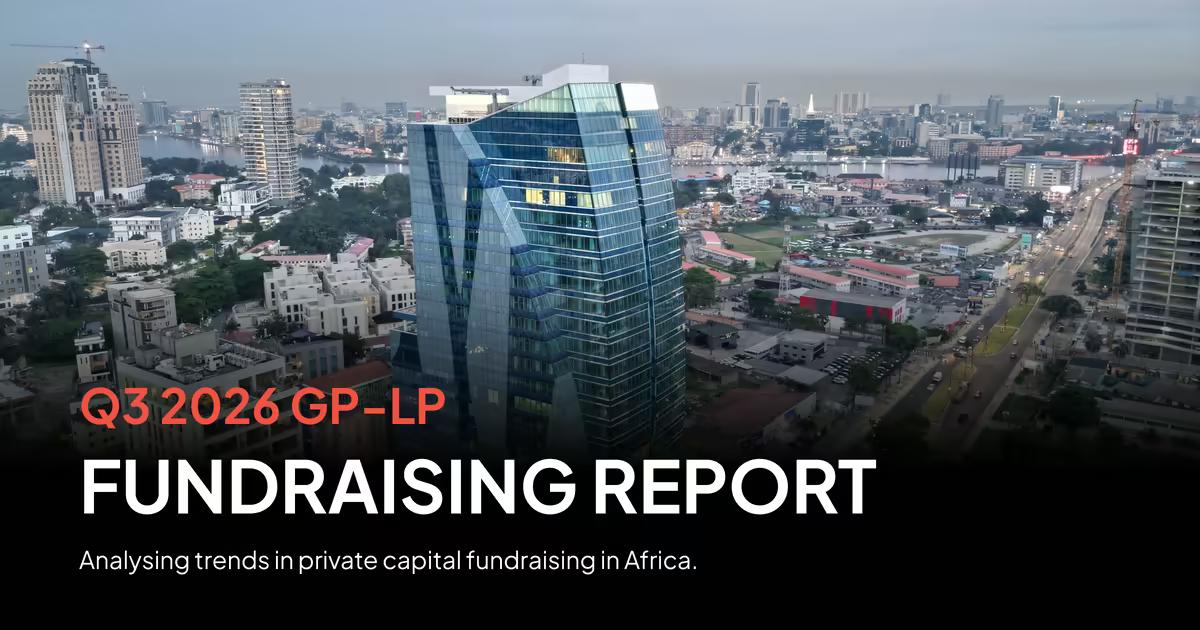
The Q1 2026 Africa Private Capital Fundraising Report analyses LP commitments into African private capital fund vehicles for Q1 2026. It examines key trends in capital formation, providing valuable insights for fund managers and institutional investors on the strategies, sectors, and fund managers attracting LP capital.
Key Takeaways
LP commitments rose across volume and value: Africa recorded 78 LP commitments into private capital fund vehicles in Q1 2026, up from 57 in Q4 2025 and 67 in Q1 2025, while disclosed commitment value rose to $870 million, compared to $750 million in the previous quarter and $498 million a year earlier.
Q1 2026 was the strongest first quarter since 2022: LP commitment volume reached its highest first-quarter level in four years, while disclosed commitment value was the highest since 2023, signalling a stronger opening quarter for African private capital fundraising after a more subdued period.
Mid-sized commitments dominated LP activity: Commitments in the $7.5 million–$25 million range accounted for 55% of disclosed commitments in Q1 2026, nearly double the 30% share of the $25 million–$75 million bucket, while commitments above $75 million remained limited.
DFIs remained the most active LPs: DEG, Proparco, and British International Investment (BII) were the most active LPs in the quarter, each recording five commitments, reinforcing the continued importance of DFIs in anchoring African private capital funds.
EIB led disclosed commitment value: The European Investment Bank (EIB) recorded $210 million in disclosed commitments, accounting for nearly a quarter of total disclosed LP capital in the period, with major allocations including $94 million to RMBV North Africa Fund III and $80 million to Apis Growth Fund III.
VC attracted the most LP commitments by volume: Venture capital accounted for the largest share of LP commitments by fund type in Q1 2026 at 36%, overtaking PE from the previous quarter, though VC represented a smaller 16% share of disclosed commitment value, reflecting the smaller average size of VC funds and LP allocations.
Private credit fundraising continued to gain traction: Private credit recorded growth across commitment value, disclosed value share, and volume share, supported by notable commitments such as BII and IDB Invest’s separate $40 million allocations to Allianz Credit Emerging Markets Fund and DEG’s $35 million commitment to Africa Go Green Fund.
LPs remained focused on core African growth sectors: Energy & Utilities (60%), Agriculture (47%), Financial Services (44%), and Information Technology (36%) were the leading sectors by commitment volume, while Financial Services dominated disclosed value, appearing in 68% of disclosed commitments.
Healthcare and Consumer Discretionary remained PE-led: 70% of Healthcare-related commitments and 60% of Consumer Discretionary commitments were allocated to PE funds, reflecting LP appetite for sectors where fund managers can back scaled companies, support expansion, and drive consolidation.
Energy fundraising spread across non-PE strategies: PE accounted for only 13% of Energy & Utilities commitments, behind VC, private credit, and infrastructure funds, reflecting the sector’s split between large-scale infrastructure projects and early-stage climate or off-grid energy solutions.
Q1 2026 Fundraising Overview
There were 78 LP commitments into African private capital fund vehicles in Q1 2026, up from 57 in Q4 2025 and 67 in Q1 2025. Disclosed commitment value also increased at the start of the year, reaching $870 million, compared to $750 million in Q4 2025 and $498 million in Q1 2025.
This growth came despite a slight quarter-on-quarter decline in disclosure rates. Only 42% of LP commitments disclosed a specific amount, down from 47% in the preceding quarter, indicating that the rise in aggregate value was driven by larger reported commitments rather than broader disclosure.
A key contributor to disclosed value in the quarter was the Development Partners International (DPI) African Development Partners IV fund, which secured substantial commitments from institutions including the International Finance Corporation (IFC), DEG, and Proparco. These commitments featured among the largest disclosed allocations in the period, alongside other notable commitments outlined in the table below.
Looking at historical first-quarter trends, Q1 2026 represents a strong start to the year for African private capital fundraising. The number of LP commitments reached its highest first-quarter level since 2022, while disclosed value was the highest recorded since 2023. This pattern suggests a renewed willingness among LPs to allocate capital to African fund managers, following a more muted fundraising environment in prior periods.
Q1 2026 Commitment Sizes
In terms of commitment sizes, activity was concentrated in the $7.5 million–$25 million range, which accounted for 55% of disclosed commitments during the quarter. This was almost double the share of commitments in the $25 million–$75 million range (30%), indicating a clear skew towards mid-sized allocations. The distribution was more concentrated than in Q4 2025, where the gap between these two buckets was narrower.
Larger commitments above $75 million remained limited. This reflects the typical structure of African private capital fundraising, where most funds are sized so as not to require many very large anchor commitments. It also aligns with the composition of the LP base, which is still dominated by development finance institutions, funds of funds, and mid-sized institutional investors that tend to deploy capital in measured ticket sizes across multiple managers.
Q1 2026 LP League Tables
The most active LPs in the quarter were three development finance institutions (DFIs): DEG (Germany), Proparco (France), and BII (United Kingdom). Their prominence reinforces the central role these institutions continue to play in anchoring African private capital funds, particularly in periods where fundraising conditions remain uneven.
Among domestic and Africa-focused LPs, the African Development Bank Group (AfDB) and FSD Africa Investments (Kenya) were the most active. The AfDB played a catalytic role in the Breega Africa Seed I Fund, Breega’s first venture capital (VC) fund dedicated to Africa, while FSD Africa Investments supported the Persistent Africa Climate Venture Builder Fund, a vehicle managed by Persistent Energy Capital focused on early-stage, climate-positive investments.
In terms of commitment value, the EIB stood out in Q1 2026. Its $210 million in disclosed commitments accounted for nearly a quarter of total disclosed LP capital in the period. This included $80 million into Apis Growth Fund III and $94 million into RMBV North Africa Fund III. The EIB backed only three funds during the quarter, so it also had the largest average commitment size among active LPs.
Honing in on fund type, the IFC and Proparco were the most active backers of private equity (PE) funds, each supporting three vehicles. The IFC also ranked as the most active PE backer in Q4 2025, reinforcing its position as a consistent limited partner for established private equity managers operating in Africa.
Within venture capital, activity was more distributed. The Japan International Cooperation Agency (JICA), Soros Economic Development Fund, Livelihood Impact Fund, and the AfDB each backed two VC funds during the period, reflecting their continued support for early-stage innovation across the continent.
In private credit, BII and DEG recorded the highest number of commitments, with three each. This pattern highlights the role DFIs are playing in expanding the private credit ecosystem.
LP Commitments by Fund Type
By fund type, venture capital (VC) accounted for the largest share of LP commitments by volume in Q1 2026 (36%), toppling private equity (PE) from the preceding quarter.
In value terms, VC accounted for a smaller share of total commitments (16%), up from the previous quarter (8%). This distribution is consistent with the typical structure of VC fundraising, where funds are smaller, and LP commitments are correspondingly smaller.
Private credit continued to gain traction across all key metrics. The growth is most evident on a year-on-year basis, with increases in the absolute commitment value, the share of total disclosed value, and the share of overall commitment volume.
This momentum is reflected in several notable commitments during the quarter. The Allianz Credit Emerging Markets Fund secured two separate $40 million commitments from BII and IDB Invest, while the Africa Go Green Fund, managed by Cygnum Capital Asset Management and focused on climate resilience in Sub-Saharan Africa, received a $35 million commitment from DEG.
The rise in private credit fundraising aligns with broader developments in Africa’s private capital landscape. Debt financing has become an increasingly important source of capital for businesses, particularly as access to traditional bank lending remains constrained and equity funding has become more selective. In response, fund managers are expanding credit-focused strategies to meet this demand.
LP participation in private credit funds reflects this shift in allocation preferences. Investors are deploying capital into strategies that offer more predictable cash flows, shorter duration, and exposure to essential sectors.
Q1 2026 Sectoral Insights
Sector classifications in this report are multi-select, meaning that a single fund may have exposure to several sectors. As a result, each data point reflects a commitment to a fund that includes a given sector within its investment mandate, rather than a dedicated, single-sector allocation.
By volume, Energy & Utilities was the most represented sector in Q1 2026, featuring in 60% of all commitments, followed by Agriculture (47%), Financial Services (44%), and Information Technology (36%). These four sectors were also the most prominent in Q4 2025, though the order has changed a bit, indicating slight short-term shifts in LP focus. Looking at Q1 2025, the composition is also broadly similar, with one key difference: Healthcare featured among the top four sectors, while Agriculture did not.
The consistency of these sectors across periods points to a stable core of sectors that continue to attract LP capital in Africa. These sectors reflect areas with sustained demand for capital, clear growth pathways, and strong alignment with structural economic needs. They also map closely to the dominant sectors across many African economies. For example, Energy & Utilities, Agriculture, Financial Services, and Information Technology together accounted for 39% of Nigeria’s GDP in 2025, highlighting the scale and relevance of these sectors within the broader economic landscape.
When looking at disclosed commitment value, the distribution shifts. Financial Services remains the most prominent sector, appearing in 68% of disclosed commitments and accounting for a significant share of total value. Healthcare (44%) and Consumer Discretionary (43%) rank second and third by value, despite accounting for only 26% and 19% of commitment volume, respectively.
This divergence between volume and value suggests a different pattern of LP allocation. Funds with exposure to Healthcare and Consumer Discretionary are attracting larger individual commitments from a smaller group of LPs, indicating concentrated conviction among certain investors. This contrasts with sectors such as Energy & Utilities and Agriculture, where participation is broader but commitment sizes are more distributed.
Fund Types across Sectors
Across sectors, PE remains the dominant fund type in areas such as Healthcare and Consumer Discretionary. In Q1 2026, 70% of Healthcare-related commitments and 60% of Consumer Discretionary commitments were allocated to PE funds.
This pattern reflects the underlying characteristics of these sectors. Both tend to favour scaled businesses with established revenue models, where PE managers can drive value through operational improvements, consolidation, and expansion. Healthcare platforms, pharmaceutical companies, and consumer-facing businesses often require growth capital at later stages, which aligns more closely with PE strategies than with early-stage venture or structured credit approaches.
In contrast, Information Technology remains the most VC-dominated sector, with 54% of LP commitments in the sector directed to VC funds. This aligns with the structure of Africa’s technology ecosystem, where a significant share of investment activity continues to take place at the early and growth stages. As technology companies mature and scale, there is likely to be a gradual shift towards later-stage capital, including growth equity and PE strategies. Over time, this would lead to a more balanced distribution of fund types within the sector.
In Energy & Utilities, PE plays a more limited role, accounting for only 13% of sector-related commitments, behind VC, private credit, and infrastructure strategies. This distribution reflects how capital is typically deployed within the sector. Large-scale energy projects, particularly in power generation and transmission, are often structured as infrastructure investments, given their capital intensity, long development timelines, and reliance on stable, contracted cash flows.
At the other end of the spectrum, early-stage energy solutions such as off-grid systems, battery technologies, and climate-focused startups are often funded through VC. These businesses operate in nascent market segments, where innovation and scalability are key drivers of value creation. As a result, classic PE strategies occupy a narrower space within the energy ecosystem, typically focused on more mature platforms or service providers.
Private credit funds are attracting increasing LP attention, though activity remains concentrated across a limited set of sectors. In Q1 2026, only five sectors recorded LP commitments into private credit fund vehicles. Within this group, Financial Services (41%) and Industrials (39%) had the highest share of commitments directed to private credit funds.
This concentration reflects the suitability of these sectors for credit-based strategies. Financial institutions, trade finance platforms, and industrial businesses often have more predictable cash flows and clearer collateral structures, making them more suited to debt financing. The pattern suggests that while private credit is expanding, its growth is still anchored in sectors where risk can be structured and managed more effectively.
Methodology
This report is derived exclusively from the Stears Funds Database, accessible through the Stears Data Platform. The database monitors private capital fundraising activity in Africa, focusing on private equity, private credit, venture capital, and infrastructure funds. Data on Limited Partner (LP) commitments in the database are compiled from reliable third-party sources, including investor websites, press releases, and investor reports, and each LP commitment is independently verified against at least two sources.
Interpreting fund commitment data
This report analyses LP commitments into GP fund vehicles, where each recorded data point represents a single commitment made by an LP into a fund.
As such, the data should not be interpreted as the number of funds that successfully raised capital in the period. A single fund may receive commitments from multiple LPs and will therefore appear multiple times in the dataset. Funds with a smaller or more concentrated LP base will appear less frequently, even where the fund itself has made meaningful fundraising progress.
This distinction is important for interpretation. The dataset captures LP-level capital allocation decisions and should be interpreted as a measure of investor participation, commitment patterns, and market appetite.
Why this approach matters
Analysing commitments at the LP level provides a more granular view of investor behaviour and market sentiment.
First, it reflects the breadth of LP participation in African private capital. A higher number of commitments indicates a wider pool of investors actively allocating capital to the asset class, even if those allocations are concentrated in a smaller number of funds.
Second, it helps identify where LP conviction is strongest. Funds that attract multiple commitments from different LPs signal stronger market validation, as capital is being allocated repeatedly into the same strategy, manager, or geography. This allows us to distinguish between isolated fundraising success and broader investor alignment.
Third, this approach captures changes in allocation behaviour more effectively than fund counts alone. Fund-level data can mask shifts in LP activity. For example, a stable number of funds raising capital could still coincide with declining LP participation if fewer investors are backing each vehicle. Conversely, an increase in commitments may indicate growing interest even if the number of active funds remains unchanged.
This framework allows the report to assess the scale, distribution, and consistency of LP engagement with African fund managers.
Get African private capital data at stears.co